
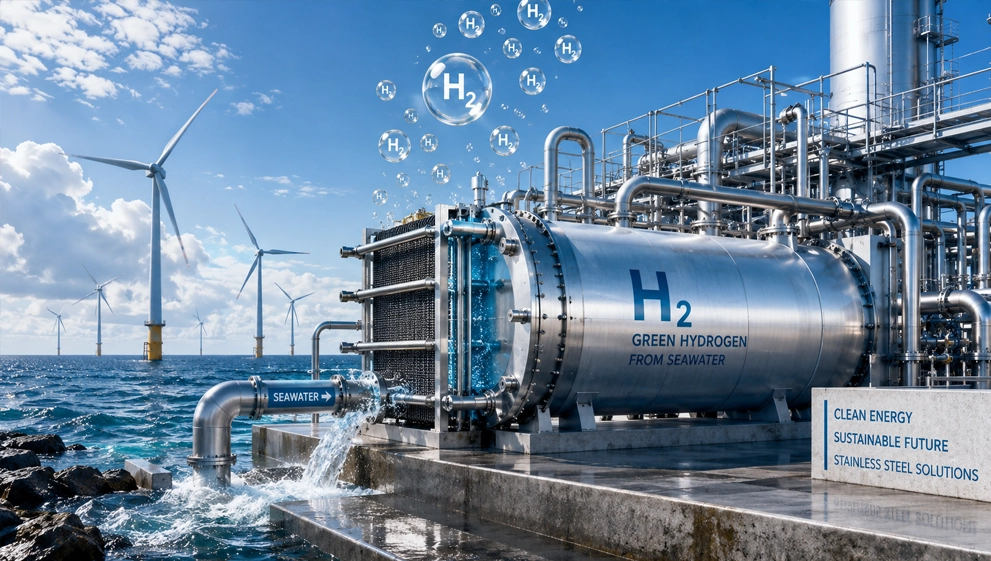
For more than a century, stainless steel has been valued for its ability to resist corrosion in demanding environments. Now, researchers at the University of Hong Kong believe they may have pushed those limits even further with the development of a new alloy designed specifically for hydrogen production. Known as SS-H₂, the material could help make green hydrogen more affordable by replacing some of the expensive titanium components currently used in industrial electrolyser systems.
Green hydrogen is produced by using electricity, ideally generated from renewable sources, to split water into hydrogen and oxygen. While seawater offers an abundant supply of raw material, its high salt content and corrosive chemistry create major engineering challenges. Conventional stainless steels can struggle under the high voltages and chloride-rich conditions involved in seawater electrolysis, leading to degradation over time.
The Hong Kong team, led by Professor Mingxin Huang, developed SS-H₂ to tackle exactly this problem. The alloy employs what researchers describe as a "sequential dual-passivation" mechanism, creating two protective layers that help the material withstand conditions that would normally push stainless steel beyond its operating limits. In testing, its performance was reported to be comparable to titanium-based materials used in hydrogen production, but at a significantly lower cost.
The breakthrough forms part of Professor Huang's long-running "Super Steel" Project, which has previously produced ultra-strong stainless steels and even an anti-COVID-19 stainless steel alloy. Researchers believe SS-H₂ could play an important role in future large-scale hydrogen production, particularly where seawater is used as the feedstock.
There is still work to do before SS-H₂ becomes a common sight in commercial hydrogen plants, but the potential is clear. If green hydrogen is to become a major part of the world's low-carbon energy future, it will depend on materials that can survive some of the harshest industrial environments on Earth. Once again, stainless steel appears ready to rise to the challenge.
After all, just like DSM Laboratory Sinks - SS-H₂ depends on a material that refuses to crack under pressure.
Visit the DSM Stainless Products website for more information on Stainless Steel Powers the Next Wave of Green Hydrogen
ENQUIRY FORM
More News