How to Calculate the Right Quantity of Aggregates for Your Next Job
Working out how much aggregate you need is an important step in any building, landscaping or driveway project. Ordering too little can cause delays, while ordering too much adds unnecessary cost and creates storage headaches. This guide explains how to calculate the right quantity, convert it into tonnes and order with confidence.
1. Measure the area
Start by measuring the length and width of the space where the aggregate will be used. Keep all measurements in metres:
-
measure the length (m)
-
measure the width (m)
If the area is an awkward shape, split it into smaller rectangles, measure each section and add the totals together.
2. Choose the correct depth
The depth you need depends on the type of project and the material being used.
Recommended depths:
-
paths and driveways: up to 50mm (0.05m)
-
decorative garden areas: 30–50mm (0.03–0.05m)
-
drainage and sub-base layers: 100–150mm (0.10–0.15m)
Make sure you convert millimetres to metres before calculating:
-
50mm = 0.05m
-
100mm = 0.10m
3. Calculate the volume in m³
Use the following formula:
Volume (m³) = length (m) × width (m) × depth (m)
Example:
-
length: 5m
-
width: 3m
-
depth: 0.05m
5 × 3 × 0.05 = 0.75m³
That is the volume of material you need in cubic metres.
4. Convert cubic metres to tonnes
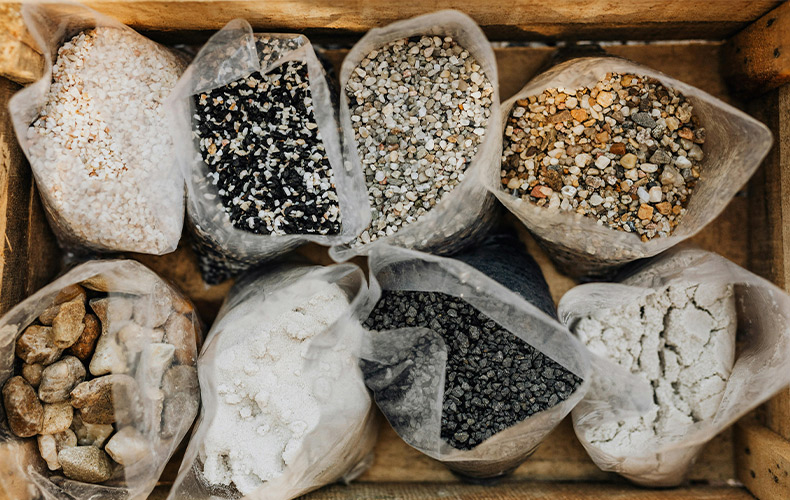
Aggregates are usually sold by weight (tonnes) or in bulk bags, so you will need to convert your m³ figure into an approximate weight. Different materials have different densities, so the conversion will vary.
Typical average densities:
-
gravel: 1.6–1.8 tonnes per m³
-
sand: 1.5–1.7 tonnes per m³
-
crushed stone: 1.4–1.6 tonnes per m³
-
MOT Type 1: 1.9–2.1 tonnes per m³
Example using gravel at 1.7 t/m³:
0.75m³ × 1.7 = 1.275 tonnes
It is sensible to round up slightly to allow for compaction, levelling and a bit of spillage, so you would order around 1.3 tonnes.
If you are ordering bulk bags, each bag is usually around 850kg to 1 tonne depending on the product.
5. Use the Mainland Aggregates quantity calculator
To save time, you can enter your measurements into the free calculator on the Mainland Aggregates website. Select your material, enter your length, width and depth, and the tool will estimate how many tonnes or bulk bags you need. It is a simple way to reduce waste and get the order right first time.
6. Ask for expert guidance
If you are not sure which material is best for your project, or whether your chosen depth is suitable, the team can help. Mainland Aggregates supplies a full range of decorative aggregates, quarried aggregates and more, and can answer questions before you place an order.
Conclusion
Calculating how much aggregate you need does not have to be complicated. Measure the area, convert the depth, work out the volume, then convert to tonnes using the correct density for the material you are using. By following these steps, or by using the online calculator, you can order confidently, avoid delays and keep your project on budget.
For accurate estimates and high-quality materials delivered nationwide, shop with Mainland Aggregates today.
Visit the Mainland Aggregates Ltd website for more information on How to Calculate the Right Quantity of Aggregates for Your Next Job
ENQUIRY FORM