How Much Gravel Do I Need? Homeowner’s Guide
To calculate how much gravel you need, measure the length, width and required depth of the area, then multiply these figures together.
Length × width × depth = volume of gravel required
Choosing the correct depth is important. A decorative garden border will not need the same amount of material as a driveway, patio base or shed foundation. It is therefore better to calculate the quantity according to the specific project rather than relying on a general coverage figure.
A gravel calculator can also be used to enter your measurements and estimate how much material is required in bulk bags, tonnes or cubic metres.
How do I calculate how much gravel I need?
Calculate the volume by multiplying the area by the required depth.
For example, if an area measures 10ft × 6ft (3m × 1.8m) and the gravel needs to be laid at a depth of 2 inches (50mm), the calculation is:
3m × 1.8m × 0.05m = 0.27m³
This means you will need approximately 0.27 cubic metres of gravel before allowing for uneven ground, compaction or waste.
How much gravel do I need for a driveway?
A gravel driveway will usually require a compacted sub-base around 4–6 inches (100–150mm) deep, followed by a gravel surface layer of approximately 2 inches (50mm).
The sub-base provides the strength needed to support vehicles, while the surface layer creates the finished appearance and helps with drainage.
If you are only topping up an existing driveway, you may need just 1–2 inches (25–50mm) of surface gravel. A new driveway will normally require both the deeper sub-base and the decorative or functional gravel finish.
A driveway measuring 16ft × 10ft (5m × 3m), with gravel laid at 2 inches (50mm), would require around 0.75m³ of surface gravel. A full new driveway would also need a separate sub-base beneath it.
How much aggregate do I need for a patio or paving base?
A patio or paved area will usually require a compacted sub-base around 3–4 inches (75–100mm) deep, followed by a bedding layer of approximately 1–2 inches (25–50mm).
Although gravel may not form the visible finish, aggregates remain an important part of the structure underneath. MOT Type 1 is commonly used to create a stable sub-base, while sharp sand or grit sand may be used as a bedding or levelling layer, depending on the paving system.
A patio measuring 13ft × 10ft (4m × 3m), with a 4-inch (100mm) sub-base, would require around 1.2m³ of material before allowing for compaction.
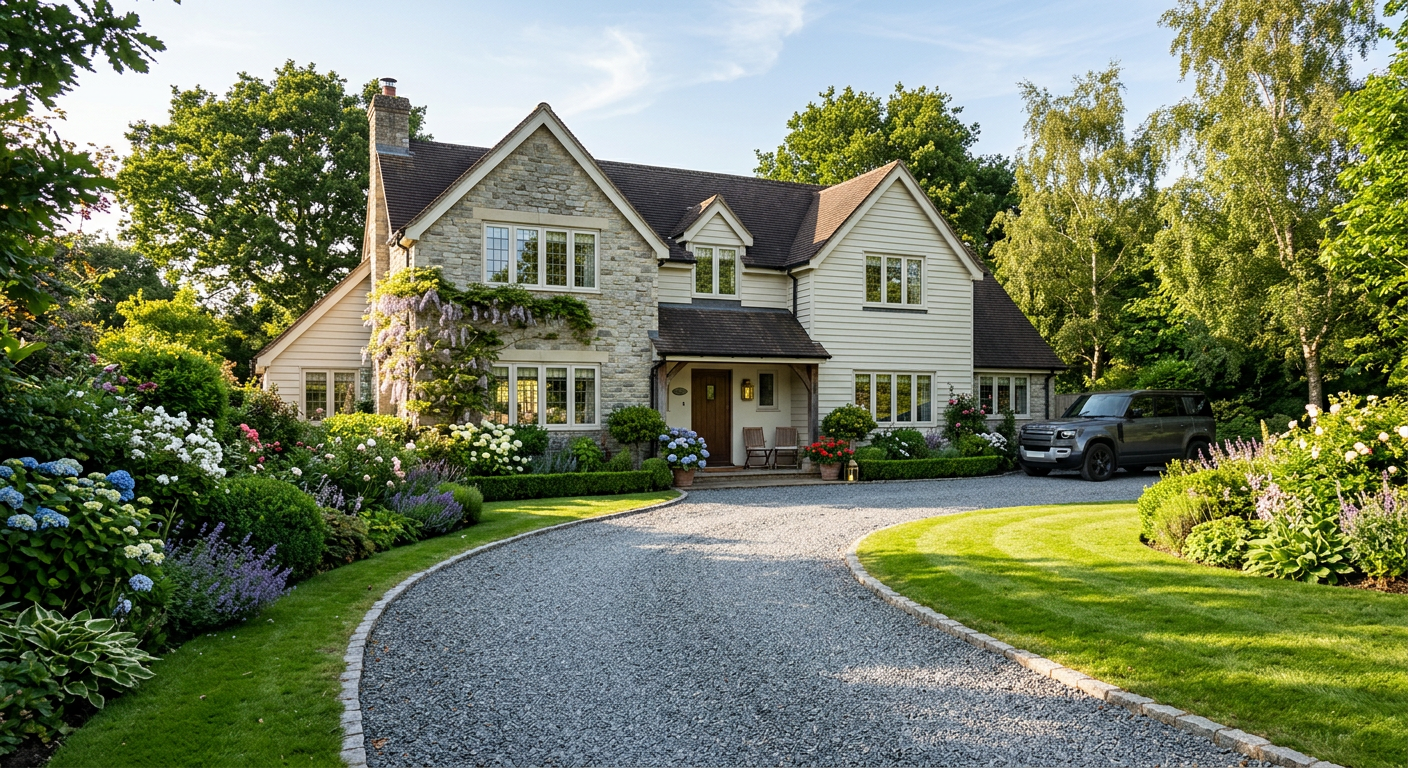
How much gravel do I need for a garden path?
A garden path will usually need gravel laid at around 2 inches (50mm) deep. Heavier-use paths may also require a compacted sub-base.
For a lightly used decorative path, gravel alone may be sufficient if the ground is firm and properly prepared. For a main garden route, bin path, side access or shed path, a sub-base will help prevent the gravel from sinking, spreading or becoming uneven.
A path measuring 20ft × 3ft (6m × 0.9m), laid at 2 inches (50mm) deep, would require around 0.27m³ of gravel.
How much gravel do I need for a decorative garden area?
Decorative gravel is usually laid at a depth of approximately 1.5–2 inches (40–50mm).
This should provide enough material to cover the soil or membrane evenly and create a clean finish. Decorative gravel is commonly used in borders, around planters, in front gardens, beside paving and in low-maintenance landscaping schemes.
A decorative area covering 10m², with gravel laid at 2 inches (50mm) deep, would require around 0.5m³ before allowing for uneven ground or waste.
How much aggregate do I need for a shed or garden office base?
A small shed base may require around 3–4 inches (75–100mm) of compacted aggregate. A larger garden office may need 4–6 inches (100–150mm) or more, depending on the size and weight of the structure.
The heavier the building, the more important the base becomes. A lightweight shed may be installed on paving slabs over a compacted base, while a larger garden office may require a deeper sub-base, concrete pad or a more carefully specified foundation.
A shed base measuring 8ft × 6ft (2.4m × 1.8m), with a 4-inch (100mm) aggregate layer, would require around 0.43m³ of sub-base material.
How much gravel do I need for drainage?
The quantity needed for drainage will depend on the project. Simple surface drainage strips may use around 2–4 inches (50–100mm) of gravel, while French drains and soakaways must be sized according to the trench, pipework, ground conditions and expected water volume.
Drainage gravel does more than provide surface coverage. It must offer enough space around the pipe or drainage area to allow water to move freely through the material.
Clean gravel or shingle is generally more suitable than decorative stone containing fine particles, as the water needs to drain through it effectively.
Why does gravel depth vary between projects?
The required depth changes because gravel performs a different role in each type of project.
A garden border only needs enough material to cover the soil. A driveway must support vehicle weight. A patio needs a stable base beneath the paving. A drainage trench needs sufficient clean stone to allow water to flow, while a shed or garden office base must reduce movement over time.
As a general guide:
- Decorative borders: 1.5–2 inches (40–50mm)
- Garden paths: 2 inches (50mm)
- Driveway surface: 2 inches (50mm)
- Driveway sub-base: 4–6 inches (100–150mm)
- Patio sub-base: 3–4 inches (75–100mm)
- Shed base: 3–6 inches (75–150mm)
- Drainage gravel: project-specific
This is why a gravel calculator is most useful once you have identified the correct depth for the project.
Should I order extra gravel?
It is sensible to order slightly more than the exact calculation suggests.
Ground is rarely completely level, and some material may be lost through spreading, compaction or uneven areas. This is particularly relevant for driveways, paths, sub-bases and larger landscaping projects.
Allow a small additional margin for uneven ground, compaction, awkward shapes, spreading losses and future top-ups.
For decorative areas, the extra amount may be small. For driveways and sub-bases, ordering enough material is especially important to avoid running short partway through the work.
Frequently asked questions
How deep should gravel be laid?
Gravel is often laid at around 2 inches (50mm) for decorative areas, paths and driveway surface layers. Driveways, patios and shed bases will normally require a deeper compacted sub-base underneath.
How much gravel do I need for 10 square metres?
For an area of 10m² laid at 2 inches (50mm) deep, you will need approximately 0.5m³ of gravel before allowing for compaction, waste or uneven ground.
How much gravel do I need for a driveway top-up?
A driveway top-up may require around 1–2 inches (25–50mm) of gravel, depending on the condition and depth of the existing material.
Do I need a sub-base under gravel?
A sub-base is usually required beneath driveways, patios, shed bases and heavily used paths. Decorative borders and lightly used garden areas may not need one if the ground is stable.
How much area does a bulk bag of gravel cover?
The coverage will depend on the weight of the bag and the depth at which the gravel is laid. A bulk bag will cover a larger area at a shallow decorative depth than it will when used for a deeper driveway or base layer.
Can I use the same gravel depth for every project?
No. Decorative areas, paths, driveways, drainage projects and shed bases all require different depths because the material performs a different function in each application.
What is the easiest way to calculate how much gravel I need?
Measure the length and width of the area, decide on the correct depth for the project, then use a gravel calculator to estimate the amount required in bulk bags, tonnes or cubic metres.
Visit the Mainland Aggregates Ltd website for more information on How Much Gravel Do I Need? Homeowner’s Guide
ENQUIRY FORM