Can Self Binding Gravel Be Laid on Concrete
Self-binding gravel is a popular choice for garden paths and heritage-style landscaping because, once compacted, it forms a firm surface with a natural look. One of the most common questions is whether it can be laid directly over concrete, tarmac or existing paved paths.
Why concrete isn’t an ideal base
Self-binding gravel relies on controlled moisture and proper compaction to create a stable finish. To perform well, it needs to be laid on a suitable free-draining, compacted sub-base, such as MOT Type 3.
Concrete and old paving slabs are impermeable, so water can’t drain naturally through them. If self-binding gravel is laid directly on top, moisture can become trapped between the hard base and the gravel layer.
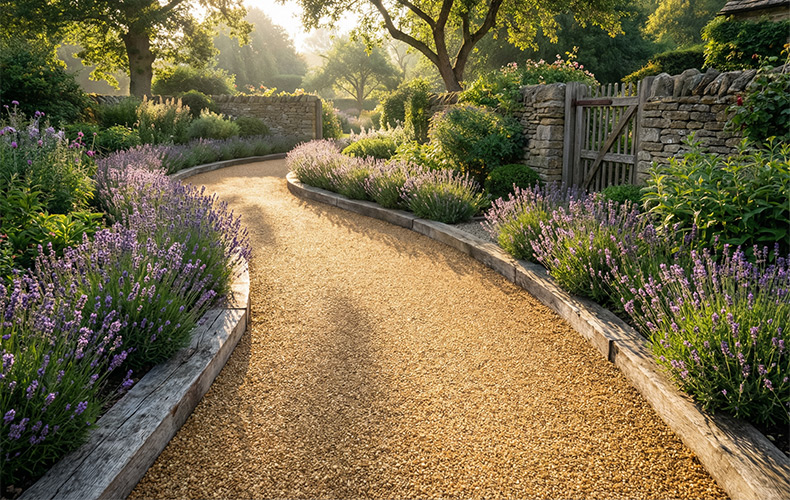
Poor drainage is the most common cause of surface failure. When water can’t disperse correctly, problems such as soft or spongy patches, cracking, surface movement, and moss or algae growth are far more likely. Over time, the surface can break down because the binding fines lose strength when they are constantly wet.
The importance of drainage
Even with the correct sub-base, self-binding gravel should always be installed with a camber or crossfall so water runs off rather than sitting on the surface.
Concrete paths are often very flat. If you simply spread self-binding gravel over the top, water is more likely to pool. Without a proper fall, the material will deteriorate more quickly.
A well-installed surface should shed water away from buildings and allow it to disperse safely and naturally.
Can it ever be done?
If you want to keep an existing concrete base, it would need to meet several conditions. The concrete must be stable and free from cracking, there must be enough depth to install a free-draining sub-base above it, and the finished surface must include a camber or crossfall.
In practice, simply adding a thin layer over slabs won’t last. At Mainland Aggregates, we generally advise against laying self-binding gravel over a concrete base.
Installation conditions matter
Self-binding gravel shouldn’t be laid when it’s soaking wet or completely dry. If it’s saturated, you’ll struggle to compact it properly. If it’s too dry, the fines won’t bind as they should. Ideally, the material should be slightly damp so it knits together under compaction.
For pedestrian paths, typical minimum compacted depths are around 50–75 mm. Cutting corners on depth or ground preparation will almost always shorten the life of the surface.
The practical recommendation
Using an existing concrete path as a base might seem cost-effective, but long-term performance depends on drainage and structure. In many cases, removing the old surface and building up from a correctly prepared, free-draining sub-base delivers a far better, longer-lasting result.
If you want a self-binding gravel surface that stays firm, stable and low maintenance, good groundwork is essential.
Visit the Mainland Aggregates Ltd website for more information on Can Self Binding Gravel Be Laid on Concrete
ENQUIRY FORM