The Fire Safety Crisis in UK Timber Frame Buildings: Why Precast Concrete Offers the Solution for a Safer Future
The devastating Grenfell Tower fire in 2017 marked a watershed moment for building safety in the United Kingdom, exposing critical flaws in the nation’s approach to fire safety and building regulations. While much attention has focused on cladding systems, a parallel concern has emerged regarding the fire safety of timber frame buildings, particularly during construction phases. This comprehensive analysis examines the alarming statistics surrounding fires in UK timber frame buildings, explores the groundbreaking recommendations of Dame Judith Hackitt’s independent review, and demonstrates how precast concrete construction offers a superior solution for meeting the new building safety standards reshaping the industry.
The urgency of addressing building fire safety cannot be overstated. Between April 2009 and March 2012 alone, Fire and Rescue Services in England attended 2,485 fires in buildings recorded as being of timber frame construction [1]. Among these incidents, 531 resulted in heat and flame damage exceeding 20 square meters, with 176 occurring in dwellings and 340 in non-residential buildings [1]. These statistics represent more than numbers; they reflect a systemic challenge demanding immediate attention and innovative solutions.
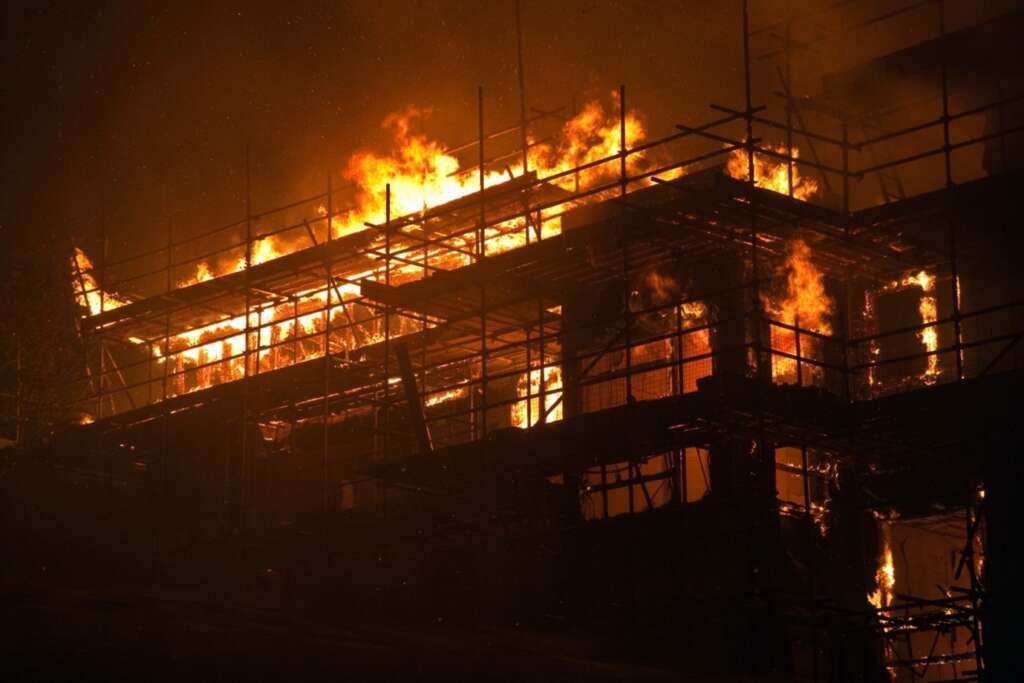
The timber frame building fire in Basingstoke demonstrates the rapid spread and intensity characteristic of such incidents. Source: New Civil Engineer
The timber frame building fire in Basingstoke demonstrates the rapid spread and intensity characteristic of such incidents. Source: New Civil Engineer
The Timber Frame Fire Challenge: Understanding the Scale of the Problem
The vulnerability of timber-frame buildings to fire represents one of the most pressing safety challenges facing the UK construction industry today. Government analysis reveals that fires in timber-frame dwellings experience significantly more damage than buildings of conventional construction methods. Of the 176 fires recorded in timber-framed houses during the 2009-2012 period, 23% resulted in heat and flame damage exceeding 100 square meters, compared to only 11% of the 4,135 fires in dwellings of no special construction [1].
This disparity becomes even more pronounced when examining buildings under construction. The construction phase represents a period of particular vulnerability for timber frame structures, with fires in timber-framed dwellings under construction showing dramatically larger damage areas than conventional construction. A staggering 24% of fires in timber-framed dwellings under construction resulted in damage exceeding 100 square meters, compared to merely 4% for homes without special construction [1].
The speed and intensity of fires in timber frame buildings during construction have become legendary within the fire service community. Industry experts warn that timber frame buildings are highly vulnerable to fire during construction, with fire chiefs cautioning that the speed at which fires engulf sites puts the lives of construction workers and fire services at risk [2]. The arrangement of timber during the construction process creates conditions that allow fire to rip through sites in minutes, with the last decade witnessing numerous catastrophic site fires [2].
High-profile incidents have underscored the severity of this challenge. In 2006, a blaze tore through a six-storey housing development under construction in Colindale, North London, burning the entire structure to the ground in less than nine minutes [2]. This incident served as an early warning of the risks associated with timber frame construction. Four years later, in 2010, a construction site in Peckham, South London, burned with such ferocity that the fire swept to nearby housing, forcing the evacuation of tenants as flames spread through their housing estate [2].
The intensity of these fires often overwhelms traditional firefighting capabilities. Most timber frame construction fires burn with such intensity that fire services rarely manage to extinguish them, instead preferring to let them burn out in a controlled manner while dampening nearby buildings to prevent heat damage [2]. This approach, while pragmatic, highlights the fundamental challenge posed by timber as a construction material in fire scenarios.
Construction Phase Vulnerabilities: The Arson Factor
The vulnerability of timber frame buildings extends beyond accidental fires to include deliberate acts of arson, representing a significant portion of construction site fires. According to industry analysis, arsonists cause most construction site fires, with sites particularly vulnerable to attack during nighttime hours when the industry rarely employs 24-hour surveillance [2]. The prohibitive cost of security means the construction industry has resisted calls to enhance security measures, even to protect valuable construction equipment [2].
The Arson Prevention Bureau has identified a concerning correlation between economic conditions and fire claims, noting that fire incidents rise during difficult financial times, with young people often identified as the culprits [2]. This pattern suggests that timber frame construction sites face inherent fire risks and increased vulnerability during economic stress, when security measures may be further reduced due to cost pressures.
The combination of inherent material vulnerability and external threats creates a perfect storm of fire risk during the construction phase. Unlike completed buildings, which benefit from fire detection systems, sprinkler systems, and compartmentation, buildings under construction lack these protective measures, leaving them entirely dependent on the fire resistance characteristics of their structural materials.
Construction sites face significant fire risks, particularly during timber frame assembly phases. Source: Firehouse Magazine
Construction sites face significant fire risks, particularly during timber frame assembly phases. Source: Firehouse Magazine
Fatality Rates and Human Cost
While the property damage statistics for timber frame fires are alarming, the human cost requires careful examination. Government analysis indicates that fatality and non-fatal casualty rates are very similar in dwellings of timber frame construction compared to those of no special construction [1]. This finding suggests that while timber frame buildings may experience more extensive property damage, the immediate life safety risks to occupants in completed buildings may not be significantly different from conventional construction.
However, this statistical similarity should not obscure the broader safety implications. The rapid spread of fire in timber-frame buildings, particularly during construction, creates heightened risks for construction workers and emergency responders. The speed at which fires develop in timber-frame structures leaves little time for evacuation and emergency response, potentially increasing the severity of incidents when they do occur.
Furthermore, the extensive property damage associated with timber frame fires has broader implications for community safety and housing security. When entire buildings are destroyed, as frequently occurs with timber frame construction fires, the displacement of residents and the loss of housing stock create secondary impacts that extend far beyond the immediate fire incident.
The Hackitt Report: A Blueprint for Building Safety Reform
The tragic Grenfell Tower fire, which claimed 71 lives and left hundreds homeless, catalysed the most comprehensive review of building safety regulations in decades [3]. Dame Judith Hackitt’s independent review, published in May 2018 as “Building a Safer Future,” delivered a damning assessment of the UK’s building safety system and provided a roadmap for fundamental reform [3].
The report’s central finding was unequivocal: “The current system of building regulations and fire safety is not fit for purpose and a culture change is required to support the delivery of safe buildings, both now and in the future” [3]. This stark conclusion reflected years of systemic failures that had allowed dangerous practices to proliferate throughout the construction industry.
Dame Judith’s analysis identified six critical weaknesses in the existing system that directly relate to the challenges of timber frame construction. First, the roles and responsibilities of those procuring, designing, constructing, and maintaining buildings were found to be unclear, creating accountability gaps that allowed safety issues to persist unaddressed [3]. Second, the regulations and guidance package were ambiguous and inconsistent, making it difficult for industry professionals to understand and implement proper safety measures [3].
Third, the processes driving compliance with building safety requirements were identified as weak and complex, with poor record keeping and change control evident in too many cases [3]. This finding is particularly relevant to timber frame construction, where the rapid pace of assembly and vulnerability during construction phases require meticulous safety oversight. Fourth, competence across the system was patchy, suggesting that many professionals lacked the knowledge and skills to assess and manage fire safety risks properly [3].
Fifth, the product testing, labelling, and marketing regime was deemed opaque and insufficient, creating conditions where inappropriate materials could be specified and used without correctly understanding their fire performance characteristics [3]. Finally, residents’ voices often went unheard, even when safety issues were identified, representing a fundamental failure of the system to protect those it was designed to serve [3].
The Hackitt Recommendations: A New Regulatory Framework
Dame Judith’s response to these systemic failures recommended a comprehensive new regulatory framework built around outcomes-based regulation, where industry takes responsibility for its actions rather than simply following prescriptive rules [3]. The government responded by fully supporting all 53 recommendations of the Hackitt report, recognising that a radical systemic overhaul was required [4].
The Building Safety Act 2022 implemented key reforms recommended by Dame Judith Hackitt's review. Source: Mogers Drewett legal firm
The Building Safety Act 2022 implemented key reforms recommended by Dame Judith Hackitt’s review. Source: Mogers Drewett legal firm
The cornerstone of the new framework is the establishment of a Joint Competent Authority (JCA) comprising Local Authority Building Standards, fire and rescue authorities, and the Health and Safety Executive [3]. This body would oversee the better management of safety risks in high-rise residential buildings, providing the coordinated oversight that was previously lacking.
Central to the new approach is the concept of rigorous roles and responsibilities for “duty holders” – primarily building owners – who would be required to demonstrate a stronger focus on building safety throughout the building lifecycle [3]. This represents a fundamental shift from the previous system, where responsibility was often diffused among multiple parties, making accountability difficult to establish.
The framework introduces a series of robust gateway points that require duty holders to demonstrate to the JCA that their plans are detailed and robust before proceeding to the next phase of construction [3]. This staged approach is particularly relevant to timber frame construction, where the vulnerability during construction phases demands enhanced oversight and verification of safety measures.
A single, more streamlined regulatory route would oversee building standards to ensure that enforcement can and does occur where necessary [3]. This consolidation addresses the previous fragmentation that allowed safety issues to fall through regulatory gaps.
The new framework also emphasises clearer rights and obligations for residents to maintain fire safety, working in partnership with duty holders [3]. This represents a recognition that building safety is not solely a technical issue but requires ongoing engagement between building managers and occupants.
Perhaps most significantly for the construction industry, the framework moves toward a system where ownership of technical guidance rests with industry as the intelligent lead in delivering building safety [3]. This shift places greater responsibility on industry professionals to develop and maintain appropriate standards, moving away from the previous reliance on prescriptive government guidance.
Implications for Timber Frame Construction
The Hackitt recommendations have profound implications for timber frame construction, particularly given the fire safety challenges identified in government statistics. The emphasis on outcomes-based regulation means that the construction industry can no longer rely on simply following prescriptive rules but must demonstrate that their chosen construction methods deliver safe buildings.
This creates a significant challenge for timber frame construction. The statistical evidence of increased fire damage and the documented vulnerability during construction phases suggests that timber frame buildings may struggle to meet the enhanced safety outcomes required under the new regulatory framework. The requirement for duty holders to demonstrate robust safety plans at gateway points means that the inherent fire risks of timber frame construction will face increased scrutiny.
The emphasis on competence across the system is particularly relevant to timber frame construction, where the speed of assembly and the specialised knowledge required for fire safety measures demand high levels of professional expertise. Dame Judith’s patchy competence suggests that many professionals may lack the knowledge necessary to properly manage the fire risks associated with timber frame construction.
The new framework’s focus on continuous improvement and best practice learning through membership of international bodies [3] also suggests that the UK construction industry must examine global best practices for building safety. This international perspective may highlight the superior fire safety performance of alternative construction methods, such as precast concrete, that are more widely used in other countries with strong building safety records.
Precast Concrete: The Superior Solution for Modern Building Safety
Against the backdrop of timber frame fire vulnerabilities and the demanding new safety standards established by the Hackitt report, precast concrete emerges as a construction method uniquely positioned to meet the challenges of modern building safety. The inherent properties of precast concrete address many of the fundamental concerns raised by Dame Judith’s review while providing superior fire resistance compared to timber frame construction.
Precast concrete construction offers rapid assembly and inherent fire resistance. Source FP McCann Build of Selly Oak Student Accommodation
Precast concrete construction offers rapid assembly and inherent fire resistance. Source FP McCann Build of Selly Oak Student Accommodation
Inherent Fire Resistance Properties
Precast concrete provides inherent fire protection and resiliency that starkly contrasts the vulnerabilities of timber frame construction [5]. Unlike timber, which serves as fire fuel, concrete does not combust and helps contain fires in a controlled space, a principle known as compartmentation [5]. This fundamental difference in material behaviour means precast concrete buildings can actively resist fire spread rather than contribute to fire development.
Precast concrete’s fire resistance is not dependent on additional protective systems or materials. It provides passive fire protection, which means it does not rely on another system or someone to take action [5]. This characteristic is fundamental in the Hackitt report’s emphasis on robust, reliable safety systems. Unlike timber frame construction, which may require additional fire protection measures that can deteriorate or be damaged, precast concrete maintains its fire resistance properties throughout the building’s lifecycle.
Technical analysis demonstrates that precast concrete can be designed to maintain structural integrity for up to four hours without additional fire protection, providing sufficient time to evacuate buildings and fight fires safely [6]. This performance far exceeds the capabilities of timber frame construction, where fires can consume entire structures in minutes.
Modern precast concrete buildings combine efficiency, durability, and superior fire safety.
Modern precast concrete buildings combine efficiency, durability, and superior fire safety.
Design Standards and Building Code Compliance
The fire resistance design of precast concrete is governed by well-established technical standards that align with the outcomes-based approach the Hackitt report advocates. The International Building Code (IBC) provides multiple methods for fire design, including prescriptive deemed-to-satisfy criteria that offer relatively simple and universally accepted fire design criteria [5].
The Precast/Prestressed Concrete Institute publishes comprehensive guidance in MNL 124, “Design for Fire Resistance of Precast Prestressed Concrete,” which explains the criteria included in the IBC and provides alternative design approaches for complex situations [5]. This manual holds an ICC Evaluation Service report ESR-1997 that allows its use under building codes, demonstrating the robust technical foundation underlying precast concrete fire design [5].
The precast concrete fire resistance design considers two primary factors: heat transmission endpoint and structural endpoint [5]. The heat transmission endpoint requires elements to have sufficient mass to limit temperature rise on the side opposite a fire. In contrast, the structural endpoint ensures that elements maintain enough strength to prevent collapse in elevated temperatures [5]. Careful concrete thickness and reinforcement cover design can meet these technical requirements, providing predictable and reliable fire performance.
This technical approach aligns perfectly with the Hackitt report’s emphasis on competence and clear technical guidance. Unlike timber frame construction, where fire performance can be unpredictable and highly dependent on construction details, precast concrete fire resistance can be calculated and verified through established engineering principles.
Comparative Safety Performance
The safety advantages of precast concrete become particularly apparent when compared directly with timber frame construction. While timber is highly susceptible to fire damage, concrete is inherently non-combustible and maintains structural integrity much longer and better than other materials [7]. Concrete does not emit toxic gases or smoke and does not melt or drip molten particles when exposed to high temperatures [7].
These characteristics address several safety concerns highlighted in the timber frame fire statistics. Where timber frame buildings show 23% of dwelling fires resulting in damage exceeding 100 square meters compared to 11% for conventional construction [1], precast concrete buildings would be expected to perform significantly better due to their inherent fire resistance and compartmentation capabilities.
Precast concrete construction essentially eliminates the construction phase vulnerabilities that plague timber frame buildings. Manufacturing precast elements in controlled factory conditions means the most vulnerable construction phases occur off-site, reducing the fire risk during on-site assembly. When precast elements are erected on-site, the process is typically much faster than timber frame construction, reducing the exposure period for construction-related fire risks.
Furthermore, precast concrete construction is not susceptible to the arson risks that particularly affect timber frame construction sites. The non-combustible nature of precast concrete means that even deliberate attempts to start fires are unlikely to result in significant structural damage, providing inherent protection against accidental and intentional fire incidents.
Meeting Hackitt Report Requirements
Precast concrete construction is uniquely positioned to meet the enhanced requirements established by the Hackitt report. Dame Judith’s outcomes-based approach requires construction methods that can demonstrably deliver safe buildings throughout their lifecycle. Precast concrete’s inherent fire resistance, predictable performance characteristics, and established design standards provide the foundation to meet these requirements.
Precast concrete construction emphasises competence across the system. It benefits from established professional standards, comprehensive technical guidance, and a mature industry with extensive experience in fire-resistant design. The Precast/Prestressed Concrete Institute and similar organisations provide the technical leadership and continuous improvement that align with the Hackitt report’s vision for industry-led safety standards.
Precast concrete’s predictable performance characteristics facilitate the requirement for clear accountability and robust gateway points. Unlike timber frame construction, where fire performance can vary significantly based on construction details and site conditions, precast concrete performance can be calculated and verified at the design stage, providing the certainty required for practical gateway assessments.
The new framework’s emphasis on resident engagement and ongoing safety management is supported by precast concrete’s passive fire protection characteristics. Building owners and residents can have confidence that the fire resistance of precast concrete buildings does not depend on ongoing maintenance of fire protection systems or the proper installation of additional protective measures.
Beyond Fire Safety: Additional Benefits of Precast Concrete Construction
While fire resistance represents the primary advantage of precast concrete over timber frame construction, the benefits extend far beyond safety considerations to encompass construction efficiency, durability, and environmental performance. These additional advantages make precast concrete an attractive solution for meeting the comprehensive building performance requirements of the post-Hackitt regulatory environment.
Construction Efficiency and Schedule Compression
Precast concrete construction offers significant advantages in construction scheduling, with the potential to compress construction schedules by up to 50% compared to traditional construction methods [6]. This efficiency gain results from the parallel manufacturing of precast elements in controlled factory conditions while site preparation and foundation work proceed simultaneously. Unlike timber frame construction, which requires sequential assembly of numerous small components, precast concrete construction involves rapidly assembling significant, pre-manufactured elements.
Modern concrete buildings demonstrate that fire safety and architectural excellence can be combined.
This scheduling advantage has essential safety implications beyond the obvious economic benefits. The reduced time required for on-site construction directly reduces the exposure period for construction-related fire risks. Where timber frame construction sites may remain vulnerable to fire for months during the assembly process, precast concrete construction can achieve weather-tight enclosure in weeks, dramatically reducing the window of vulnerability.
The controlled manufacturing environment for precast concrete elements ensures consistent quality and eliminates many variables affecting fire performance in site-built construction. Factory production allows for precise control of concrete mix design, curing conditions, and quality assurance procedures that would be difficult to achieve in field conditions. This consistency supports the outcomes-based regulatory approach that the Hackitt report advocates by providing predictable performance characteristics.
Durability and Lifecycle Performance
The high-performance concrete used in precast construction is highly durable, lasting much longer than other materials and reducing the cost of ownership over the building’s life [6]. This durability advantage has important implications for building safety, as it ensures that fire resistance properties are maintained throughout the building’s service life without degradation.
Unlike some fire protection systems that may deteriorate over time or require ongoing maintenance, the fire resistance of precast concrete is inherent to the material and does not diminish with age. This characteristic aligns with the Hackitt report’s emphasis on building safety throughout the building lifecycle, ensuring that safety performance does not depend on ongoing maintenance or replacement of protective systems.
The durability of precast concrete also supports the new regulatory framework’s emphasis on clear accountability for building safety. Building owners can have confidence that the fire resistance properties specified at the design stage will be maintained throughout the building’s service life, reducing the ongoing management burden and liability associated with building safety compliance.
Energy Performance and Environmental Benefits
Precast concrete buildings can be designed to act as thermal mass, storing heat in winter and cooling in summer, thereby reducing the building’s energy load [6]. This thermal mass effect can reduce the size requirements for HVAC equipment, providing both upfront cost savings and ongoing operational benefits [6]. These energy performance advantages support the broader sustainability objectives that are increasingly important in modern building design.
The environmental benefits of precast concrete construction extend beyond operational energy performance to include the embodied energy and carbon considerations that are increasingly important in building assessment. Precast concrete’s durability means that buildings have longer service lives, amortising the embodied energy over extended periods and reducing the frequency of building replacement.
The fire resistance of precast concrete also provides environmental benefits by reducing the risk of catastrophic building loss. When timber frame buildings are destroyed by fire, the ecological impact includes the loss of embodied energy in the destroyed structure and the environmental cost of demolition, waste disposal, and reconstruction. The superior fire resistance of precast concrete reduces these risks and their associated environmental impacts.
Economic Considerations and Cost-Benefit Analysis
The economic case for precast concrete construction must be evaluated in the context of the total cost of building ownership, including initial construction costs, ongoing operational costs, insurance costs, and the potential costs associated with fire incidents. While precast concrete construction may involve higher initial material costs than timber frame construction, the total cost of ownership often favours precast concrete when all factors are considered.
Insurance and Risk Management Costs
The superior fire resistance of precast concrete directly affects insurance costs and risk management. Insurance providers increasingly recognise the reduced fire risk associated with non-combustible construction, often offering reduced premiums for buildings constructed with fire-resistant materials. The extensive damage statistics associated with timber frame fires suggest that building insurance costs may increase as insurers better understand and price these risks.
The risk management benefits of precast concrete extend beyond direct fire damage, including business interruption costs, temporary accommodation costs for displaced residents, and the broader economic impacts of building loss. The rapid fire spread characteristic of timber frame construction means that fire incidents are more likely to result in total building loss, maximising these secondary costs.
For commercial and residential developers, the reduced insurance costs and improved risk profile of precast concrete buildings can provide ongoing financial benefits that offset higher initial construction costs. Precast concrete’s predictable fire performance also supports more accurate risk assessment and insurance pricing, reducing uncertainty in project financial planning.
Insurance and Risk Management Costs
The superior fire resistance of precast concrete directly affects insurance costs and risk management. Insurance providers increasingly recognise the reduced fire risk associated with non-combustible construction, often offering reduced premiums for buildings constructed with fire-resistant materials. The extensive damage statistics associated with timber frame fires suggest that building insurance costs may increase as insurers better understand and price these risks.
The risk management benefits of precast concrete extend beyond direct fire damage, including business interruption costs, temporary accommodation costs for displaced residents, and the broader economic impacts of building loss. The rapid fire spread characteristic of timber frame construction means that fire incidents are more likely to result in total building loss, maximising these secondary costs.
For commercial and residential developers, the reduced insurance costs and improved risk profile of precast concrete buildings can provide ongoing financial benefits that offset higher initial construction costs. Precast concrete’s predictable fire performance also supports more accurate risk assessment and insurance pricing, reducing uncertainty in project financial planning.
Long-term Value Proposition
The long-term value proposition of precast concrete construction is strengthened by its alignment with the evolving regulatory environment and market expectations for building safety. As the construction industry adapts to the post-Hackitt regulatory framework, buildings that can demonstrably meet enhanced safety standards will likely command premium market values.
Precast concrete construction’s durability and low maintenance requirements provide ongoing value through reduced lifecycle costs. Unlike construction methods requiring periodic replacement or upgrade of fire protection systems, precast concrete buildings maintain their safety performance without ongoing intervention, reducing costs and management complexity.
The energy performance benefits of precast concrete construction also provide long-term value through reduced operational costs and improved environmental performance. As energy costs rise and environmental regulations become more stringent, these benefits become increasingly valuable to building owners and occupants.
Recommendations for Industry and Policy Makers
The evidence presented in this analysis supports several key recommendations for industry professionals, policy makers, and building owners seeking to improve building safety outcomes in the post-Hackitt regulatory environment.
For the Construction Industry
Construction professionals should carefully evaluate the fire safety implications of their material choices in light of the statistical evidence regarding timber frame fire performance and the enhanced regulatory requirements established by the Hackitt report. The documented vulnerabilities of timber frame construction during construction and operational phases suggest that alternative construction methods may be necessary to meet the enhanced safety standards.
Professional development and competence enhancement should focus on understanding the fire performance characteristics of different construction methods and the design approaches necessary to achieve reliable safety outcomes. The emphasis on outcomes-based regulation means construction professionals must move beyond prescriptive compliance to demonstrate actual safety performance.
Industry organisations should develop enhanced technical guidance and professional standards that support the implementation of the Hackitt recommendations. The success of the new regulatory framework depends on the industry’s ability to take ownership of technical guidance and demonstrate leadership in building safety.
For Policy Makers
Regulatory authorities should consider the implications of the timber frame fire statistics when developing implementation guidance for the Hackitt recommendations. The documented fire vulnerabilities may require additional measures for timber frame construction to achieve safety outcomes equivalent to those of more fire-resistant construction methods.
Building code development should incorporate the lessons from the timber frame fire analysis and ensure that prescriptive requirements adequately address the documented vulnerabilities. The gateway point requirements should include specific consideration of construction method, fire performance, and the measures necessary to achieve acceptable safety outcomes.
Research and development funding should prioritise the development of construction methods and materials that can meet the enhanced safety requirements established by the Hackitt report. The superior performance of precast concrete suggests that non-combustible construction methods may be essential for achieving the safety outcomes required by the new regulatory framework.
For Building Owners and Developers
Building owners should consider the long-term implications of construction method choices, including fire safety performance, insurance costs, regulatory compliance requirements, and lifecycle costs. The statistical evidence regarding timber frame fire performance suggests that these factors may significantly impact the total cost of building ownership.
Due diligence processes should include a detailed evaluation of fire safety performance and the measures necessary to meet current and anticipated future regulatory requirements. The evolving regulatory environment means buildings designed to the minimum current standards may face compliance challenges as requirements grow.
Investment decisions should consider the market value implications of building safety performance, particularly as public awareness of building safety issues grows following the Grenfell tragedy and the implementation of the Hackitt recommendations.
Conclusion: Building a Safer Future with Precast Concrete
The statistical evidence regarding fires in UK timber frame buildings presents a compelling case for fundamental changes in construction practice. With 2,485 fires in timber frame buildings recorded between 2009 and 2012, including disproportionately severe damage during construction phases, the current approach to timber frame construction appears incompatible with the enhanced safety standards established by Dame Judith Hackitt’s groundbreaking review.
The Hackitt report’s call for outcomes-based regulation and enhanced accountability creates a regulatory environment where construction methods must demonstrably deliver safe buildings throughout their lifecycle. The documented vulnerabilities of timber frame construction, notably the 24% of construction-phase fires resulting in damage exceeding 100 square meters compared to only 4% for conventional construction, suggest that timber frame buildings may struggle to meet these enhanced requirements without significant additional safety measures.
Precast concrete emerges from this analysis as a construction method uniquely positioned to meet the challenges of the post-Hackitt regulatory environment. Its inherent fire resistance, predictable performance characteristics, and established technical standards provide the robust foundation for outcomes-based regulation. The passive fire protection provided by precast concrete eliminates many vulnerabilities plaguing timber frame construction, while the controlled manufacturing environment ensures consistent quality and performance.
The economic case for precast concrete is strengthened by consideration of total lifecycle costs, including reduced insurance costs, lower regulatory compliance burdens, and the avoided costs associated with fire incidents. The potential for 50% schedule compression and the superior durability of precast concrete provide additional value that often offsets higher initial material costs.
Perhaps most importantly, precast concrete construction aligns with the Hackitt report’s fundamental principle: building safety must be designed into buildings from the outset rather than added as an afterthought. The inherent fire resistance of precast concrete means that safety performance does not depend on properly installing and maintaining additional protective systems, reducing the risk of safety failures and providing the reliability necessary for public confidence in building safety.
As the UK construction industry adapts to the new regulatory reality established by the Hackitt report, the choice of construction materials and methods will play a crucial role in determining whether the vision of “Building a Safer Future” can be achieved. The evidence presented in this analysis suggests that precast concrete construction offers the most promising path toward that safer future, providing the fire resistance, reliability, and performance characteristics necessary to meet the enhanced safety standards the public rightfully demands.
The time for incremental improvements to inherently vulnerable construction methods has passed. The scale of the fire safety challenge documented in government statistics and the comprehensive nature of the Hackitt recommendations demand fundamental changes in how buildings are designed and constructed. Precast concrete construction represents not just an alternative to timber frame construction, but a superior solution that can deliver the safe, durable, and efficient buildings the UK needs for the 21st century.
The construction industry, policy makers, and building owners must now make the difficult but necessary decisions to prioritise building safety over short-term cost considerations. The human and economic costs of building fires are too high to accept construction methods with documented vulnerabilities when superior alternatives are available. Precast concrete construction offers the opportunity to build a safer future – the question is whether the industry will seize that opportunity before more lives are lost and preventable fires destroy more buildings.
References
[1] Department for Communities and Local Government. (2012). Analysis of fires in buildings of timber-framed construction, England, 2009-10 to 2011-12. Retrieved from https://assets.publishing.service.gov.uk/media/5a79c85ced915d042206afcf/Timber_frame_analysis_17_Jan.pdf
[2] Timber Frame Fires. (2025). In Construction. Retrieved from https://www.timberframefires.co.uk/in-construction
[3] Michelmores. (2020, June 12). The Hackitt Report – an overview. Retrieved from https://www.michelmores.com/real-estate-insight/hackitt-report-overview/
[4] Construction Products Association. The Hackitt Report. Retrieved from https://constructionproducts.org.uk/our-expertise/technical-and-regulatory/building-safety/the-hackitt-report/
[5] Precast/Prestressed Concrete Institute. Design for Fire Resistance. Retrieved from https://www.pci.org/PCI/PCI/Design_Resources/Building_Engineering_Resources/Design_for_Fire.aspx
[6] JVI Inc. (2020, February 27). Precast Concrete: The Perfect Material for Fire Resistance. Retrieved from https://jvi-inc.com/precast-concrete-the-perfect-material-for-fire-resistance/
[7] JVI Inc. (2020, May 7). Safety First – Precast V Timber. Retrieved from https://jvi-inc.com/safety-first-precast-v-timber/
This article was researched and written incorporating the latest available data on building fire safety, regulatory developments, and construction industry best practices. The analysis is based on official government statistics, industry reports, and technical documentation from recognised professional organisations.
CONTACT US
Head Office
3 Drumard Road
Knockloughrim
Magherafelt
BT45 8QA
028 7964 2558
sales@fpmccann.co.uk
Visit the FP McCann website for more information on The Fire Safety Crisis in UK Timber Frame Buildings: Why Precast Concrete Offers the Solution for a Safer Future
ENQUIRY FORM